DMA of 2026 APRIL 17 FRIDAY AMC.
The stock market capped an impressive week with a strong rally as retreating oil prices, improved rate-cut odds, and broadening participation pushed stocks further into record territory. The S&P 500 (+1.2%) and Nasdaq Composite (+1.5%) notched record intraday and closing highs for the third consecutive session, with the Nasdaq Composite locking in a 13th consecutive higher finish, a feat not accomplished since 1992.
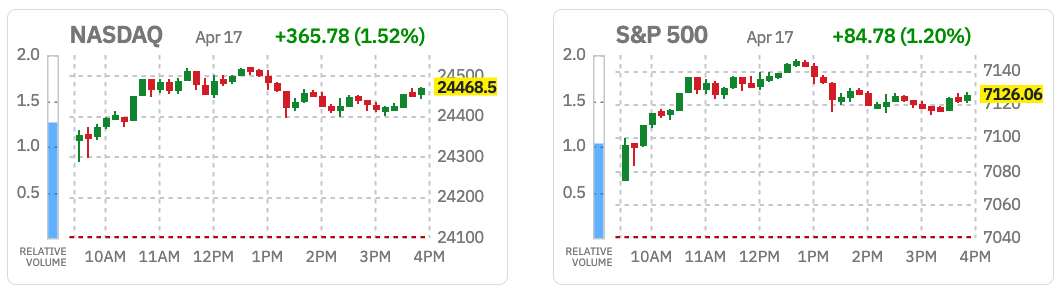
Solid participation across the broader market helped the DJIA (+1.8%) slightly outperform, while expectations for a potentially more favorable interest rate environment saw the Russell 2000 (+2.1%) and S&P Mid Cap 400 (+2.0%) capture even wider gains.
Stocks soared higher at the open following an announcement from Iran’s foreign minister that the Strait of Hormuz will reopen to commercial traffic for the remainder of the U.S.-Iran ceasefire, which is set to expire on Tuesday. Additionally, The Wall Street Journal reported that the next round of talks between the two nations is likely to take place on Monday in Pakistan, and President Trump announced that Iran has indefinitely suspended its nuclear program.
Crude oil futures settled today’s session $10.49 lower (-11.1%) at $84.22 per barrel, paving the way for broad participation and some impressive gains.
Airlines and cruise lines such as United Airlines (UAL 101.78, +6.75, +7.10%) and Royal Caribbean (RCL 285.48, +19.53, +7.34%) outperformed as oil retreated, contributing to strength in the consumer discretionary (+2.0%) and industrials (+1.8%) sectors.
Both sectors were also supported by solid gains across rate-sensitive stocks such as homebuilders and building supply names. The iShares U.S. Home Construction ETF finished 4.6% higher.
The pullback in oil prices has tempered the market’s inflation expectations, and the CME FedWatch tool is now assigning a 50% probability to a rate cut of at least 25 basis points at the December FOMC meeting, up from around 30% yesterday.
Elsewhere, the top weighted information technology sector (+1.6%) also kept pace with the gains with semiconductor stocks leading the sector’s advance, pushing the PHLX Semiconductor Index 2.4% higher.
Apple (AAPL 270.23, +6.83, +2.59%) was one of the best-performing “magnificent seven” stocks after Reuters reported China iPhone shipments increased 20% in the first quarter.
The communication services sector (+0.8%) logged one of the narrower gains today as Netflix (NFLX 97.31, -10.48, -9.72%) moved sharply lower after issuing disappointing Q2 guidance in its earnings release yesterday. Still, the sector finished well off its session lows due to strong leadership from its mega-cap components Alphabet (GOOG 339.40, +6.63, +1.99%) and Meta Platforms (META 688.55, +11.68, +1.73%). The Vanguard Mega Cap Growth ETF finished 1.4% higher.
Only the energy (-2.9%) and utilities (-0.4%) sectors finished lower.
Momentum remains firmly to the upside, with buyers continuing to push stocks into record territory with relative ease. The major averages have now notched week-to-date gains of at least 3% for three consecutive weeks, underscoring the strength of the rally as easing geopolitical tensions and improving rate-cut expectations continue to reinforce the market’s bullish backdrop.
U.S. Treasuries had a strong finish to the week, pressuring yields on most tenors to their lowest closing levels in a month. The 2-year note yield settled down eight basis points to 3.70% (-10 basis points this week), and the 10-year note yield settled down six basis points to 4.25% (-7 basis points this week).
BENCHMARK INDICES YEAR-TO-DATE
- Russell 2000: +11.9% YTD
- S&P Mid Cap 400: +10.3% YTD
- Nasdaq Composite: +5.3% YTD
- S&P 500: +4.1% YTD
- DJIA: +2.9% YTD
MARKET INTERNALS
- DOW closed higher at 49447 (+1.79%). Nasdaq closed higher at 24468 (+1.52%). S&P 500 closed higher at 7126 (+1.20%).
- Action came on higher than average volume (NYSE 1,500 mln vs avg. of 1,402 mln; NASDAQ 10,236 mln vs avg. of 9,199 mln),
- Advancing/declining volume for NYSE (1097 mln/383 mln) and Nasdaq (7159 mln/2988 mln).
- Advancers led decliners (NYSE 2168/616; NASDAQ 3690/1191)
- New 52-week highs outpacing new 52-week lows (NYSE 195/11, NASDAQ 522/52).
BONDS AND YIELDS
U.S. Treasuries had a strong finish to the week, pressuring yields on most tenors to their lowest closing levels in a month. The trading day started with slim gains after a quiet night in global markets. Asian equities faced some profit taking after a strong week, even though the market grew more confident that the Iran conflict is nearing a conclusion. That sentiment strengthened during the day after Iran’s foreign minister said that the Strait of Hormuz is open after the ceasefire agreement between Israel and Lebanon. That announcement sent the price of oil to a five-week low while Treasuries built on their slim opening gains, pressuring yields on the 10-yr note and shorter tenors to one-month lows. Later in the day, President Trump said that he expects a deal to come together in the next couple days and that Iran agreed to suspend its nuclear program indefinitely. Today’s rally put the potential for a December rate cut back on the table, with the implied likelihood of a reduction at that time now essentially a toss-up, up from just 30% yesterday. Crude oil extended this week’s loss to $12/bbl, finishing below $85/bbl, while the U.S. Dollar Index fell 0.2% to 98.01, giving up 0.7% for the week.
Yields
- 2-yr: -8 bps to 3.70% (-10 bps this week)
- 3-yr: -8 bps to 3.72% (-10 bps this week)
- 5-yr: -8 bps to 3.84% (-10 bps this week)
- 10-yr: -6 bps to 4.25% (-7 bps this week)
- 30-yr: -4 bps to 4.89% (-2 bps this week)
CURRENCIES
The dollar index fell about 0.5% to below 98 on Friday, marking its lowest level since the conflict with Iran began, as news of the temporary reopening of the Strait of Hormuz helped ease near-term inflation concerns. Iran’s Foreign Minister said that the strait is now fully open to all commercial vessels for the duration of the 10-day ceasefire. In response, oil prices tumbled more than 10%, prompting traders to ramp up bets on Federal Reserve rate cuts this year. Markets are now pricing in roughly a 50–50 chance of a 25-basis-point rate cut by year-end, up from around a 30% probability on Thursday. This still compares with earlier expectations of two rate cuts before the conflict escalated. The greenback weakened broadly, with the sharpest declines against the Swiss franc, Australian dollar, Japanese yen, and the euro. For the week, the dollar index is down about 0.5%, on track for a third consecutive weekly decline.
Currencies
- EUR/USD: UNCH at 1.1781
- GBP/USD: +0.1% to 1.3537
- USD/CNH: -0.1% to 6.8159
- USD/JPY: -0.4% to 158.43
COMMODITIES
Brent crude futures plunged 10% to below $90 per barrel and WTI crude futures plunged more than 10% to below $84 per barrel on Friday, hitting near five-week lows after Iran’s Foreign Minister Abbas Araghchi announced that the Strait of Hormuz is now fully open to commercial traffic during the ceasefire period. The move boosted optimism that one of the most severe global energy supply disruptions in recent history may be easing. The statement followed earlier remarks from President Donald Trump, who said Iranian concessions could pave the way for a broader peace deal. Prices extended losses after reports that the US may release $20 billion in frozen Iranian funds in exchange for enriched uranium stockpiles, with further talks expected this weekend. The market is increasingly pricing in an end to the conflict’s impact on supply, after nearly 50 days of disruption that had choked off a significant share of global oil flows.
The spread between Brent and WTI is currently at $6.30
Commodities
- Crude Oil -10.49 @ 84.22
- Nat Gas +0.02 @ 2.67
- Gold +74.70 @ 4880.50
- Silver +2.90 @ 81.59
- Copper +0.03 @ 6.11
Gold Prices Edge Up After Iran’s Announcement
Gold prices slightly extended gains on Friday, rising more than 1% to above $4,850 per ounce, as investors reacted to news that the Strait of Hormuz will remain fully open to commercial shipping during the 10-day ceasefire between Israel and Lebanon. However, vessels are required to transit through a “coordinated route,” according to Iran’s maritime authorities, a condition reiterated by the country’s foreign minister. The announcement triggered a sharp drop in oil prices which fell more than 10%, helping to ease inflationary pressures, at least in the short term. Despite the improved sentiment, the broader situation remains fragile. US President Trump stated that the US naval blockade “will remain in full force” until a comprehensive agreement is reached. Gold is now on track to end the week 0.8% higher, marking a fourth consecutive weekly gain, supported by expectations that a more lasting US–Iran agreement could reduce inflation risks and limit the need for central bank tightening.
Aluminum Pulls Back from 3-Year High
Aluminum futures in the UK sank to $3,550 per tonne from the three-year high of $3,670 on April 16th, as signals of resorted vessel flows through the Strait of Hormuz improved the outlook form key suppliers in the region. Iranian authorities stated that commercial vessels are now free to navigate the chokepoint following ongoing talks with the US, improving the outlook for exports from major producers in the region. Before the start of the conflict in March, aluminum output from the UAE, Qatar, and Bahrain was responsible for around 9% of global supply. Production prospects also improved elsewhere as the pullback in energy prices from the developments are likely to improve margins for Asian and European smelters. Still, output is unlikely to immediately rebound to pre-war levels as facilities in Qatar and Bahrain faced damage, while power prices remained higher this year.
Copper Rises to Over 2-Month High
Copper futures in the US rose to above $6.1 per pound, the highest in over two months and tracking the increase in most industrial metals as signals of restored trade through the Strait of Hormuz improved the outlook of manufacturing activity and pressured the dollar. Iranian authorities stated that commercial vessels crossing the Strait of Hormuz will no longer be targeted, backing hopes of restored fuel supply from the region and improving operation costs for major manufacturers, which supports demand for industrial metals. In the meantime, the softer pivot to safety drove the US dollar to depreciate, supporting bidding for foreign consumers. Physical demand had already been supported by China as firms enter their restocking season. Longer-term demand was also supported by growing investment in electrification investments in grids, datacenters, and electric cars.
Silver Prices Rise About 5%
Silver extended gains on Friday, climbing around 5% to reach $82 per ounce, as investors welcomed news that the Strait of Hormuz will remain fully open to commercial shipping during the 10-day ceasefire between Israel and Lebanon. However, vessels are required to transit through a “coordinated route,” according to Iran’s maritime authorities, Iran’s foreign minister said. The announcement triggered a sharp drop in oil prices which fell more than 10%, helping to ease inflationary pressures, at least in the short term. Despite the improved sentiment, the broader situation remains fragile. US President Trump stated that the US naval blockade “will remain in full force” until a comprehensive agreement is reached. Silver is now on track to end the week 3.6% higher, marking a fourth consecutive weekly gain and is nearly 30% above its March low, supported by expectations that a more lasting US–Iran agreement could reduce inflation risks and limit the need for central bank tightening.

Baltic Dry Index Extends to Over 4-Month High
The Baltic Exchange dry bulk freight index climbed 1.7% to 2,567 on Friday, its highest level since December 8, extending gains for an eleventh consecutive session and posting a weekly rise of 16.6%. The capesize index, which tracks vessels carrying around 150,000 tons of cargo such as iron ore and coal, jumped 2.5% to 4,128, a more than four month high. The panamax index, typically used for 60,000 to 70,000 ton shipments of coal or grain, edged up 0.3% to 1,975, the strongest level since early March. Meanwhile, the supramax index advanced 1.2% to 1,415.
ROTW UPDATES
Equity indices in the Asia-Pacific region had a mostly lower showing to end the week with Japan’s Nikkei (-1.8%) backing down from record territory.
- Japan’s Nikkei: -1.8%,
- Hong Kong’s Hang Seng: -0.9%,
- China’s Shanghai Composite: -0.1%,
- India’s Sensex: +0.7%,
- South Korea’s Kospi: -0.6%,
- Australia’s ASX All Ordinaries: -0.1%.
In news:
- Expectations for an April rate hike from the Bank of Japan have continued receding with the market growing concerned that the lack of a hike could spark a drop in the yen.
- The People’s Bank of China increased the cap on bank lending to offshore entities.
- Fitch noted that China’s credit outlook remains bogged down by weak domestic demand.
In economic data:
- Singapore’s March trade surplus SGD11.22 bln (last surplus of SGD4.57 bln). March non-oil exports 3.0% m/m (last 3.9%); 15.3% yr/yr (last 4.0%)
- New Zealand’s March Electronic Card Retail Sales 0.7% m/m (last 1.4%); 2.7% yr/yr (last 1.5%). March FPI -0.6% m/m (last -0.1%)
Major European indices are seeking a mostly higher finish to the week while the U.K.’s FTSE (-0.4%) lags amid weakness in miners, energy, and consumer names.
- STOXX Europe 600: +0.1%,
- Germany’s DAX: +0.5%,
- U.K.’s FTSE 100: -0.3%,
- France’s CAC 40: +0.4%,
- Italy’s FTSE MIB: +0.6%,
- Spain’s IBEX 35: UNCH.
In news:
- French train manufacturer Alstom has fallen about 30% after withdrawing its free cash flow guidance.
- European Central Bank policymaker Muller said that it should not be assumed that the energy shock will be temporary, adding that he is not ruling out a rate hike this month.
In economic data:
- Eurozone’s February trade surplus EUR11.5 bln (expected surplus of EUR11.7 bln; last deficit of EUR1.0 bln). February Current Account surplus EUR24.9 bln (expected surplus of EUR29.8 bln; last surplus of EUR40.4 bln)
- Italy’s February trade surplus EUR4.944 bln (expected surplus of EUR3.83 bln; last surplus of EUR1.13 bln)
U.S. ECONOMIC UPDATES
- President Trump says the Iran war is “going along swimmingly” and “should be ending pretty soon”, according to CNBC
- The UK and France hold a summit on plan to secure the Strait of Hormuz, according to FT
- Iran likely has a reason to negotiate because of its destroyed economy, according to WSJ
- Ceasefire between Israel and Lebanon appears to be holding, according to NBC News
- A senior Gulf area official says President Trump will accept more compromises to end the war with Iran, according to Politico
- Democratic candidate Analilia Mejia wins New Jersey House special election, according to NBC News
- The Trump administration asks oil companies to increase drilling, according to FT
- FAA announces new action, known as scheduling reduction, to prevent widespread flight delays at Chicago O’Hare International Airport
- President Trump says Iran agrees to indefinite nuclear program suspension, according to Bloomberg
- Norwegian shipowners’ association says clarifications are needed before transit can resume in Strait of Hormuz, according to Times of Israel
- President Trump says “Iran, with the help of the U.S.A., has removed, or is removing, all sea mines!”
- Iran says it will close Strait of Hormuz again if U.S. blockade continues, according to Bloomberg
- A maritime security company advises tankers not to cross Strait of Hormuz and wait for further guidance from authorities, according to WSJ
- U.S. mulls increasing uranium imports from Namibia, according to Bloomberg
- Iran affiliated media says the social media post this morning from Iran Foreign Minister Seyed Abbas Araghchi was a “bad and incomplete tweet”; says Iranian armed forces will oversee ship movement through Strait of Hormuz – CNBC
- President Trump in an interview with Axios says he expects Iran deal within the next two days
- Iran says U.S. blockade is a violation of ceasefire and will take action if blockade continues, according to Bloomberg
- White House considering sending Vice President JD Vance to Pakistan for another round of talks with Iran on Monday, according to CBS News
- Commodities agency Kpler says Strait of Hormuz remains closed despite Iran’s pledge, according to WSJ
- First cruise ship transits Strait of Hormuz since Iran war began – CNBC, citing Marine traffic data
- President Trump in an interview with CBS News reporter Weijia Jiang says no ground troops will be required to remove enriched uranium from Iran; says Iran has agreed to stop backing all proxy groups like Hezbollah and Hamas
- U.S. and Iran talks will likely be held Monday in Pakistan, according to WSJ
EARNINGS SEASON AND GUIDANCE
- Alcoa (AA) misses by $0.13, misses on revs; Expects 2026 total Alumina segment production and shipments to remain unchanged from its prior projection
- Ally Financial (ALLY) beats by $0.18, misses on revs
- Autoliv (ALV) beats by $0.22, beats on revs
- Badger Meter (BMI) misses by $0.29, reports revs in-line
- Capital Southwest Corp. (CSWC) expects Q4 2026 pre-tax net investment income in the range of $0.59-0.60 per share
- Cohen & Steers (CNS) misses by $0.02, beats on revs
- Ericsson (ERIC) misses by SEK0.76, misses on revs
- Fifth Third (FITB) beats by $0.25
- First Financial Bankshares (FFIN) beats by $0.03
- F.N.B. Corp (FNB) reports EPS in-line, NII decreased 1.7%
- Knight-Swift (KNX) lowers Q1 EPS guidance below consensus, issues in-line Q2 EPS guidance
- Netflix (NFLX) beats by $0.47, reports revs in-line; guides Q2 EPS and revs below consensus; reaffirms FY26 revs guidance; recent price changes have gone well; ad revs on track to reach $3B in 2026
- Polestar Automotive Holding UK PLC (PSNY) reports Q4 results, revenue increased by 50.3% yr/yr; Guides for low double-digit volume growth for 2026
- Regions Fincl (RF) beats by $0.02, misses on revs
- Santacruz Silver Mining (SCZM) reports Q1 2026 production of 1,341,499 ounces of silver and 21,640 tonnes of zinc, with continued recovery of production at Bolivar Mine
- SANUWAVE Health (SNWV) expects Q1 revenue of $9.6-9.7 mln, in line with prior guidance
- Silvercorp Metals (SVM) reports record revenue and provides FY27 production outlook
- Simmons First National (SFNC) reports EPS in-line, revs in-line
- State Street (STT) beats by $0.20, beats on revs
- Truist (TFC) beats by $0.09, reports revs in-line; guides Q2 revs below consensus; guides FY26 revs in-line
- Vale S.A. (VALE) reports Q1 production results
- WaFd, Inc. (WAFD) beats by $0.07
2026 APR 20
Pre-Market: BOH CLF
After-Hours: ALK BOKF STLD WTFC ZION
ANALYSIS
A penguin will be volunteered for this post soon, or if incentivised with enough cheese.
COMMENTARY
On the home front, my SPX IC Call win is still (barely) OTM. I decided to play the waiting game, as I still have 14+ days left. In retrospect, cutting losses when the IC turned negative days earlier would have been a much better move. I will need to develop some rules for this.
Another painful lesson in the learning process.
Stay Hedged – My Penguin Friends
(Excerpts from briefing.com, tradingeconomics.com, financialscents.com, factset.com, finviz.com, marketwatch.com, etrade.com, yahoo.com, tigerbrokers.com, tradingview.com, tradingcentral.com, theedgemalaysia.com, sectorspdrs.com, Investopedia.com, and CNBC.com)